At Morehouse Farm Merino Wool, we are NOT getting into plastics.
But we came up with a way to use our knitting skills and help preserve
the environment at the same time. And we wanted to share our ideas for
a greener life with you.

Prep Work:
cut plastic bags into strips. Depending on the thickness of the plastic bag, cut strips
different widths: really thin plastic bags (the flimsy kind for bagging veggies) cut into
4” to 5” wide strips; and the more solid plastic shopping bags into 3” to 4” wide strips.
To get maximum lengths, cut bags spiral-wise. An average-size plastic bag will yield a strip
about 4 yards long. Roll strips loosely into balls. You may want to sort your strips by
plastic thickness and/or colors (color on bags, clear or opaque plastic, etc.) or you may prefer
a more random approach and knit with whatever you have ready.
Don’t worry about cutting strips into even widths. Strips of varying widths create interesting
effects from thick-thin stitches (check the Beach Bag at right with the different stitch sizes).
And nicks, rips and tears don’t matter once you start knitting with the strips.
Tips:
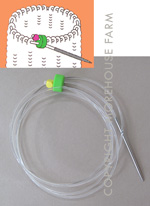
for knitting, use a wood
or bamboo circular needle. Stainless steel needles don’t work—the plastic
stitches stick like glue to stainless steel. When joining a new strip, simply knit 3 stitches with
end of old strip together with beginning of new strip. You may want to leave the tufts of ends and
beginnings sticking out as a decorative touch (see detail at right) or you can trim them off. Forget
darning in or sewing together—it simply doesn’t work! The Beach Bag is knit all in one piece. When
knitting handles, use strips from strong plastic bags or knit with 2 strips together for added strength.
|

Cut off handles, then cut
plastic bags into strips

Roll the strips of plastic
loosely into balls

When starting new strips,
leave short tufts from end
and beginning of strips
sticking out as decoration |

Length:
to suit height of dog (and dog walker!)
Crochet Hook: I or J (or larger); 5.5 mm or 6.0 mm
Other Material: clasp (new ones are available at hardware
stores, or use clasp from a broken or worn leash)
You’ll need 1 heavy plastic shopping bag for Dog Leash (we used a Barnes & Noble shopping bag,
the sturdy kind with handles; but any strong plastic bag will work)
Cut off handles, then cut plastic bag into 2” wide strips.
Start with Handle: leave 5” tail, then start with slip knot, your first loop
(see illustration); then crochet until you have a cord 11” long. Fold in half and crochet next loop
through slip knot, then use tail from beginning together with strip you are working with and crochet
next few chain stitches using both tail and strip together. Continue until entire length of tail is
worked in, then continue with strip single and crochet until leash is desired length (from 30” to 50”,
depending on height of dog).

Adding Clasp: work 2 to 3 stitches by pulling loop of strip through end of clasp
(see illustration); then begin second row back towards beginning of leash. You may want to add second
row along entire length (especially for a very strong dog) or just a few inches to secure clasp and
finish leash.

For strong or unruly dogs,
add a second row.
|


Use 3½" clasp for a leash
for a medium to large dog;
3" clasp for a small dog


Leave a 5" tail, then start
with slip knot


Crochet chain stitch


Finished handle


Finished Dog Leash with
single row of chain stitch
|

Watch for details coming up in our next Newsletter.
Not yet a subscriber?.. Subscribe here
|
Page: 1 2

Size: about 15" wide and 18" long
(not including handles)
Needle: 24" circular #15 and
24" circular needle #10 or #11
Gauge: don't bother!

The Shopping Tote we featured last year makes a fabulous Beach Bag. So here is the
pattern again — with minor changes (slightly longer handles and beach-themed
decoration on side of bag).
Handles and Top Border: start with the smaller needle and use strong plastic strips
(strips cut from heftier plastic shopping bag; or use 2 strips together) and cast on 90 stitches.
Join and knit 6 rounds. Next round: knit 12 stitches, bind off the next 21 stitches loosely, knit
24 stitches, then bind off the next 21 stitches and knit remaining 12 stitches. Next round: knit
the first 12 stitches, then cast on 5 stitches using e-loop cast-on; knit the next 24 stitches
and cast on 5 stitches again; then knit the remaining 12 stitches. You now have 58 stitches.
Knit 3 or 4 more rounds with smaller needle.
Body of Bag: switch to #15 needle and use ordinary plastic strips and knit until bag
measures 18” from cast-on edge. Bind off using three-needle bind off as follows: put the 2 tips
of the circular needle parallel to each other—one behind the other—with half the stitches on the
front tip and the other half of the stitches on the back tip. Use the smaller needle and bind off
stitches from front needle together with stitches on needle in back (in other words: you’ll knit
first stitch together with last stitch, next knit second stitch together with second to last stitch;
now bind off first stitch. Knit third stitch together with third to last stitch, and bind off second
stitch, etc. Pull plastic strip through last stitch and pull end through to inside of bag. Tie together
with last bind-off stitch. Then cut end, leaving a short tuft. And that’s it!
Finishing: decorate side of bag with beach finds: shells, sea stars, etc. (they are available
at crafts stores). Use glue for stars and drill small holes into shells then sew on like buttons
using strong sewing thread.

Take a break from recycling plastic,
and knit with Morehouse Merino Wool.
Here are some Earth-friendly suggestions:
Want to share this idea with someone?
Enter eMail address of your friend here,
then click, to send them a link to this page.
|